Demo
And Texts For Reading
With
Proportional Reading
Audio Files (white) Linked Below
PR Book Videos and PR Lesson Videos
1A. Fairy Tale: Aladdin and the Wonderful Lamp
-
-
(Middle School level books are #1B-1M. High School and up level books start with #2. All files can be read with Apple’s VoiceOver.)
-
-
1B. Alice’s Adventures In Wonderland by Louis Carroll
-
-
1C. The Legend Of Sleepy Hollow by Washington Irving
-
-
1D. The Secret Garden by Frances Hodgson Burnett
-
-
1E. The Wind In The Willows by Kenneth Grahame
-
-
1F. Aesop’s Fables by an unknown Slave
-
-
1G. Fairy Tales by Hans Christian Anderson V1
-
-
1H. Fairy Tales by Hans Christian Anderson V2
-
-
1I. Robinson Crusoe by Daniel Defoe
-
-
1J. Anne of Green Gables by Lucy Maud Montgomery
-
-
1K. Little Women by Louisa May Alcott
-
-
1L. The Autobiography of Benjamin Franklin
-
-
1M. A Christmas Carroll by Charles Dickens
-
-
2. College Textbook: Maternity Nursing (by Sentence and by Punctuation Interval)
-
4. Historical Speech: Lincoln’s Second Inaugural (by Sentence)
5. Legal Document: 12th Amendment (by Punctuation Interval)
-
6.The Outcasts of Poker Flat
7. Mystery: Sherlock Holmes: The Hound of the Baskervilles
-
-
8.Comparison of Formatted and Unformatted Text: The first three paragraphs of A Tale of Two Cities
-
9.The Thirty-Nine Steps
-
-
10.Genesis
-
11.On The Duty of Civil Disobedience by Henry David Thoreau
As HTML Document Without Additional Pausing
-
12.Silas Marner by George Eliot
By Sentence & “;” in Paragraph F30
-
13.The Adventures of Huckleberry Finn
14. Moby Dick by Herman Melville
15. The Call of the Wild by Jack London
Library of 72 Great Classics (Free)
Call Us for Free Initial Consultation:
978-927-9234
Immediate Help for Falling Asleep, Reading Anxiety, Poor Comprehension, Poor Memory, Slow Speed, Dyslexia, ADHD, Low Vision, and ESL
(All Ages and All Levels)
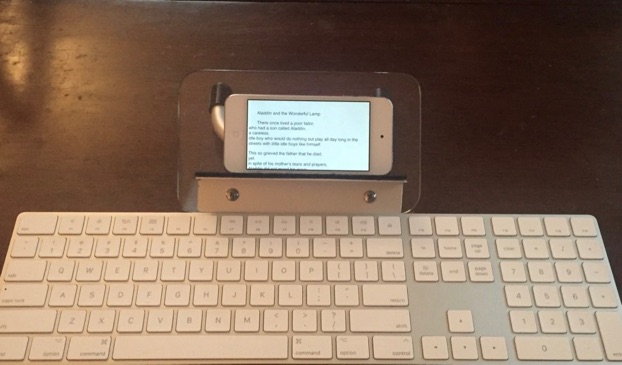
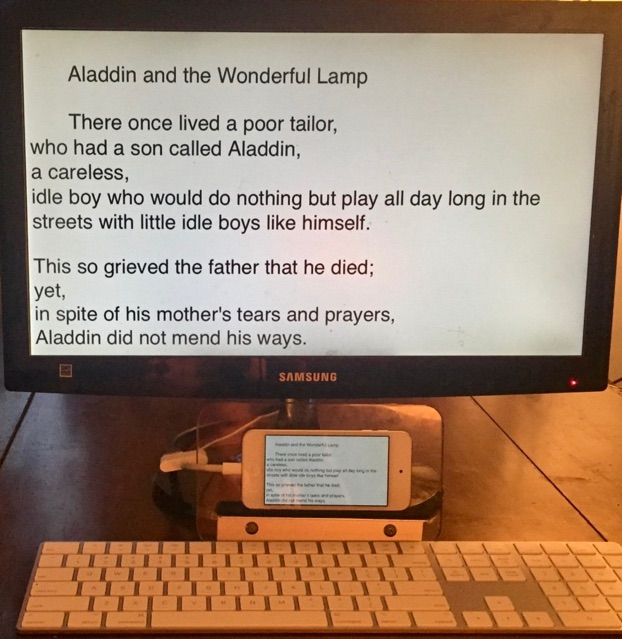
Ideal Setup: iPod Touch 6, or iPhone, With or Without a Monitor, on Compact Device Holder
Getting Started with Voice and Text and Proportional Reading
It's important to have your Apple devices up to date with the latest software. , , This means that at the minimum you should have High Sierra, Mac OS 10.13 or higher, installed on your laptops or desktops; on your iOS devices you need to have iOS 11 or higher installed.
The big picture of operation is important to understand. , , You can do this program on an iOS device by itself; or better yet with a wireless, Bluetooth, Apple Magic Keyboard with Number Pad. , , In addition, you can use an adapter and HDMI cable and run the signal from your iOS device to a monitor screen. , , In addition, you can run the signal from your iOS device to your Apple TV and from there to a monitor or regular TV. , , These are the options for using iOS devices. , , You can also use an Apple laptop or desktop, which is better, but much more expensive.
Note: On an Apple laptop or desktop the font size of the text can be immediately enlarged or collapsed by pressing command+ or command-.
The rest of this paper will assume that you are working on an iOS device because it is much cheaper for the same functionality, and most people already have iPhones or iPads, etc., or access to them.
Also, the rest of this paper will assume you are using your iOS devise to read articles on the Internet, using Safaris as your default browser. Note: Reading articles as attachments on E-mail from your teacher or someone else has a few important variations.
Any existing HDMI monitor can be used. , , Almost every classroom and home already has one or more of these. , , Three or four iPod Touches and Magic Keyboards can easily be rotated each day between 6 or 7 classes for simultaneous small group use in each classroom. , , In each group the Bluetooth Magic Keyboard passes from one student to the next. , , No one moves their seat.
If you enlarge the text on your iOS screen, be sure to shrink it down by pinching the text with your two fingers before you go into VoiceOver; otherwise all the text won't appear on the screen.
Also, be sure to close the bookmarks window, if it is open; this will make more room for the text you want to read.
VoiceOver is the official name of Apple’s text to voice program.
The basic way to turn VoiceOver on or off is by triple clicking the home key. , , You need to set this up in settings. , , In actual practice, you only triple click the home key to close VoiceOver; to open VoiceOver it's much better to use Siri. , , Why is this? Asking Siri to "Turn VoiceOver On" and then pressing the home button, allows you to immediately touch the text at the spot you were last at, and VoiceOver will commence at that point. , , Otherwise, VoiceOver will automatically begin at the beginning of the article, which is a nightmare if you're reading a long work.
You must practice with the Siri voice and “Turn VoiceOver On” in order to get the knack of beginning to read where you left off. , , Of course, if you just want to start at the beginning of the text, you can press the home button three times.
Before you start VoiceOver, you want to make sure that the header and footer panels are off the screen, and all you see is text. , , To do this just move the panel of text up slightly with your finger before turning VoiceOver on.
Also, you want to use the “find text” feature to locate your last words read, before you turn on VoiceOver. , , To do this click on the “share box” that is the box with the up arrow in the top middle of it, then go to the second row of icons and almost all the way to the far right. , , There you will see a magnifying glass. , , Click on this magnifying glass and the “find window” will open up. , , You can type in the text you wish, or even use Siri. , , Be sure to click “done” before you turn VoiceOver on, or the “find window” will stay up.
The best way to read a book or article, or chapter is to write down the last three words that you have read. , , This can be on an electronic message or note on your iOS device, or on a separate piece of paper. , , Then, when you come back to your iOS device to continue reading, you just type in those words in the “find window”, and you will go right to where you left off, even in a thousand page novel.
The best way to look up words is on a secondary device, like your smart phone. , , Otherwise, you have to interact with VoiceOver as you switch in and out of the dictionary application, and this is cumbersome.
The best way to raise and lower the voice speed on an iOS device, is to get into VoiceOver and then touch the screen with two fingers and rotate your two fingers, which brings up the rotor. , , Keep rotating the rotor until you see “speaking rate” show up at the top of the Rotor. , , Then flick one finger on the screen up or down to adjust the speed about 5% at a time; you will hear sample text out loud so you can check the speed. , , Before leaving, rotate the rotor to “words”, so you won't accidentally change the speed by a stray finger stroke.
When you plug an HDMI cable and the adapter into your lightning port, a fixed volume sound is produced, for TVs with built-in speakers. , , If you want to have an adjustable sound, plug in earphones or use a wireless Bluetooth set of earphones. , , After you turn VoiceOver on, you may have to reinsert the earphone plug to get controllable sound. , , You could also use an audio cable to go to a power speaker. , , Using a Bluetooth speaker is another option.
Always remember that you can get out of VoiceOver anytime you wish by pressing the home button three times. , , This of course assumes that you have set up the home button action to do this, which you do in settings.
It is not necessary to use VoiceOver to do this program. , , A close friend on the phone at home, or a rotating person in a small group in the classroom can act as the computer voice. , , This way any person with an existing smartphone, regardless of make, can do this program.
The best way to read most articles with Voice and Text is on the Internet, rather than with specialized apps. This way, you will have a fully functional Voice and Text program, and you will usually be able to read in landscape mode. You can also easily remove the adds, create a magazine format and enlarge the text. Perhaps most importantly, the page up and page down keys on your keyboard will work.
Understanding The Use of Voice and Text In Reading Improvement
In our program, called Proportional Reading, there are three main ways you interact voice with text. , , To begin with, you try to read the text out loud on your own and then hear the text read out loud with computer voice, and repeat the voice if you have made a mistake, or need to read the section of text fluently. , , After you get very good at this, you start to read the text silently, hearing the computer voice, at the same speed and at the same time. , , Thirdly, you start to read the text silently ahead of the computer voice, thinking about what you are reading as the voice catches up to where you have just paused. , , Using this last technique you can read any text at 350-500 words per minute with excellent comprehension. , , This is a lifelong skill.
Initially reading a phrase at a time, or reading a punctuation interval at a time, or reading a full sentence at a time is done by you first reading out loud, and then pressing a button to hear the text read with a computer voice. , , In order to do this, you want to be able to see all of the text you are supposed to read out loud before you start.
You always want to read from the top of a screen of text down to the bottom of the screen of text, and then bring up a new screen of text. , , Otherwise, the only way to proceed is to add a line of text at the bottom of the screen, over and over again as you proceed. , , This causes a great deal of jumping around on the screen, which will quickly put you to sleep. , , You also won’t be able to see the text for as long as you want before hearing it read out loud, which starts immediately.
Just like in reading an actual book, when you get to the bottom of one page, you “turn the page” and start to read at the top of the next page. , , This is how you do it with an iOS device or computer:
The proper way to read text in Proportional Reading is to stop at the bottom of the page. , , If the text has already stopped because you have heard the end of the section, just press the “page down” key and you will move to the top of the next page. , , You can do this even if you have one or two lines still showing at the bottom of the page. , , You will have all the time you need to locate and then read the next line of text. , , When ready you can press the “Forward Arrow” key to have that line of text read.
Note: If you are reading a whole paragraph at a time, you can just press the “Forward Arrow” key, and the next paragraph will center on the screen. , , As soon as the text appears, optionally press the “control” key to pause the reading out loud, until you are ready for it; then press “control” again to hear the sound. , , You can easily proceed through a paragraph this way, reading a punctuation interval or sentence out loud at a time, before hearing it read with computer voice.
If the text continues on past the bottom of the page, without stopping, use the following approach. , , Press the “control key” to pause the sound when you get to the last word on the page. , , Then press the “page down” key to bring up the next screen of text. , , Now locate where the last word is. , , Usually this will be at the right margin of the page, two or three lines down. , , Once you have located the last word, press the “control key” again to continue with sound to the end of the paragraph. , , It is very easy to read long paragraphs of text with this approach.
Note: As mentioned earlier, if you just press the forward arrow key at the bottom of the screen, the next section of text will jump onto the screen and will start reading before you've had a chance to locate your place or read it yourself.
You can use your fingers on the screen of an iOS device to touch any particular section of text and have it read. , , You can use your fingers, without needing to use a keyboard. , , To repeat the line of text, just press it again. , , This is OK for very short lines of text, but not for long sentences and paragraphs which continue past the bottom of the screen.
In Proportional Reading when we talk about presenting a sentence at a time within the paragraph, we mean that there is a single hard return at the end of each sentence. , , Also each “;” may be treated as a period at the end of the sentence. , , This means that there may be a single hard return at the end of each semicolon as well. , , This is done as a step in getting ready for long sentences and paragraphs, to keep from being overwhelmed by too much text at a time.
Anytime you are reading a long section of text, you can pause the computer reading out loud instantly and for as long as you want by pressing the “control” key. , , Just press the “control key” again to resume sound.
Using the keyboard is at least twice as fast as using your fingers on the screen of an iOS device. , , Furthermore, almost no attention has to be paid to what you are doing, especially when reading a phrase or punctuation interval at a time, which are almost always less than the width of a line on the screen. , , Being able to read a long paragraph with continuity of sight and sound is now finally possible with the “page down” key of the Magic Wireless Apple Keyboard with Numeric Pad.
This keyboard can be bought at any Apple store for $129.00 plus tax. , , The iPod Touch 6 costs $199.00 plus tax. , , You can use your existing HDMI monitor or TV. , , The Apple HDMI to Lightening Adaptor costs $49 at the Apple Store. , , The iPod Touch comes with a set of earphones and a Lightening Cable. , , A Charging block is necessary and costs $19. , , With this dirt-cheap set up all students can get hundreds of hours of independent, interactive, voice and text practice with customized settings at home and/or at school.
Our Course has 12 Classes of Instruction; each class is 40 min long. , , We teach a progression of skills and concepts for a lifetime of reading empowerment. , , Any book or Internet article can be read with this approach.
Learn How to Setup Your iOS Devise for VoiceOver and Proportional Reading.
Learn the iOS Operational Controls for VoiceOver and Proportional Reading.
Learn How to Setup Your Mac Laptop or Desktop for VoiceOver and Proportional Reading.
Learn the Mac (Laptop and Desktop) Operational Controls for VoiceOver and Proportional Reading.